
NEET Exam Pattern 2026
Marking Scheme, Question Format & Important Topics
NEET UG 2026 Exam Pattern: Structure, Questions, and Marking System
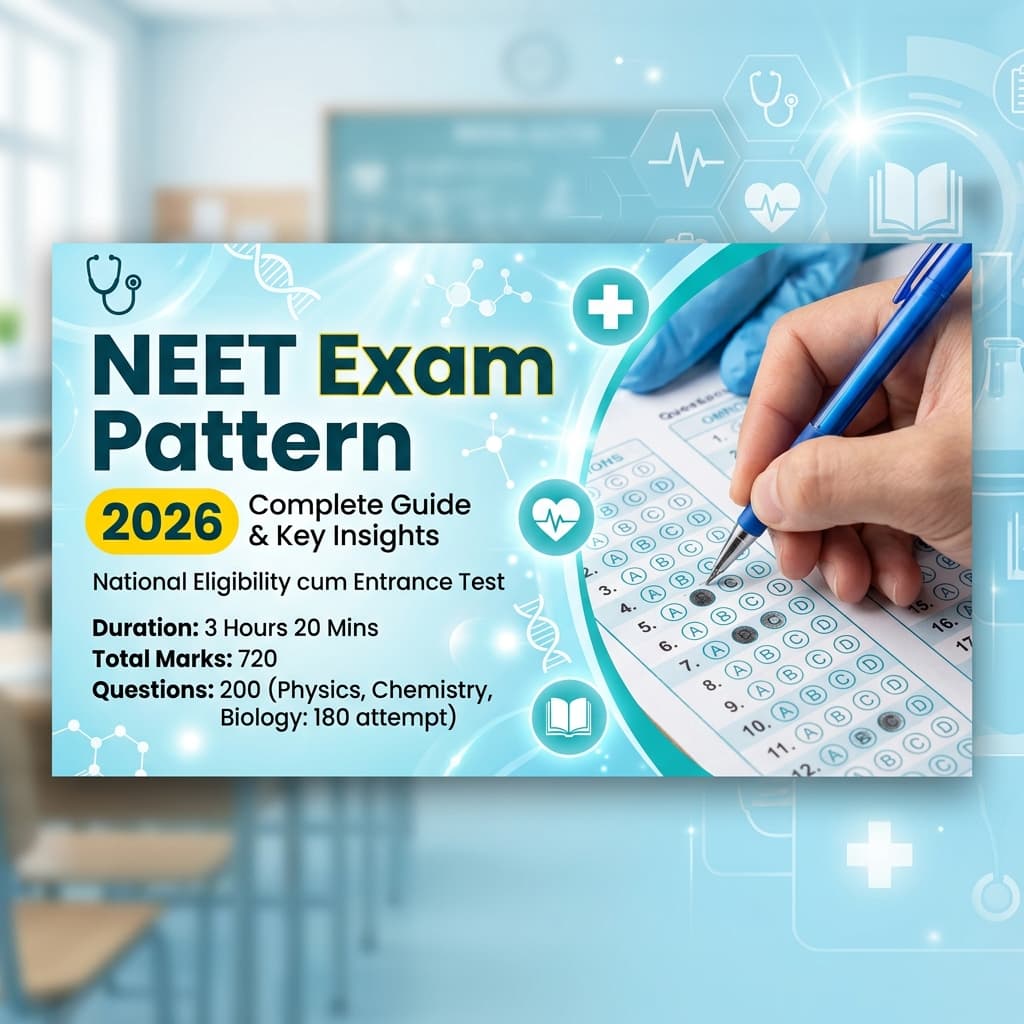
The structure for the NEET UG 2026 examination adheres to the established format, requiring candidates to attempt a total of 180 compulsory questions. Spanning Physics, Chemistry, and Biology (Botany & Zoology), the test evaluates students out of a maximum of 720 marks. Conducted exclusively in an offline pen-and-paper mode, the exam duration is fixed at 3 hours (180 minutes). A thorough understanding of this structure is crucial for candidates to optimize their test-taking strategy and time management.
Comprehensive Exam Structure
| ASPECT | SPECIFICATION |
|---|---|
| Exam Name | National Eligibility cum Entrance Test (NEET) UG 2026 |
| Organizing Authority | National Testing Agency (NTA) |
| Mode of Examination | Offline (Pen and Paper, OMR Sheet based) |
| Total Duration | 3 Hours (180 Minutes) |
| Total Questions | 180 (All Compulsory) |
| Maximum Marks | 720 |
| Question Type | Multiple Choice Questions (MCQs) with 4 options |
| Marking System | +4 for every correct answer, -1 for every wrong answer |
Subject-Wise Marks Distribution
The exam consists of four distinct subjects. Each subject carries specific weightage. Understanding this distribution helps candidates allocate their preparation time efficiently.
| SUBJECT | NUMBER OF QUESTIONS | ALLOCATED MARKS |
|---|---|---|
| Physics | 45 | 180 |
| Chemistry | 45 | 180 |
| Botany | 45 | 180 |
| Zoology | 45 | 180 |
| Total | 180 | 720 |
Note: All 180 questions are compulsory. There are no optional questions in the current pre-Covid format structure.
Detailed Marking Scheme
| RESPONSE TYPE | IMPACT ON SCORE |
|---|---|
| Correct Response | +4 Marks |
| Incorrect Response | -1 Mark (Negative Marking) |
| Unanswered Question | 0 Marks |
| Multiple Bubbles Marked | -1 Mark (Treated as incorrect) |
Crucial OMR Sheet Guidelines
- ✔Authorized Pens: Strictly use the black or blue ballpoint pen provided at the examination hall.
- ✔Correct Bubbling: Ensure the circles are completely filled without any stray ink marks outside.
- ✔No Modifications: Do not attempt to erase or use correction fluid. Multiple marked bubbles lead to negative marking.
- ✔Handle with Care: Do not fold, crumple, or staple the OMR sheet, as it may cause rejection during machine scanning.
High-Yield Subjects & Key Topics for NEET 2026
| SUBJECT | CRITICAL TOPICS |
|---|---|
| Physics | Mechanics (Laws of Motion, Work Energy Power), Thermodynamics, Electrodynamics (Electrostatics, Current Electricity, Magnetic Effects), Optics, and Modern Physics. |
| Chemistry | Physical (Atomic Structure, Thermodynamics, Equilibrium), Organic (Basic Principles, Hydrocarbons, Aldehydes/Ketones), and Inorganic (Chemical Bonding, Coordination Compounds). |
| Biology | Cell Biology, Human Physiology, Genetics & Evolution, Plant Physiology, Ecology & Environment, and Biotechnology. |
Expert Strategies to Crack NEET 2026
Master the Syllabus
Stick closely to the NCERT curriculum for grades 11 and 12 across all three subjects.
Structured Timetable
Build a realistic daily and weekly study schedule that balances learning and revision.
Premium Resources
While NCERT is your primary source, use standard reference materials for advanced problem-solving.
Rigorous Mock Testing
Take timed full-length tests and solve past year papers (PYQs) to build stamina.
Continuous Revision
Maintain concise formula sheets and flashcards for quick daily reviews.
Target Weaknesses
Identify concepts where you lose marks consistently and devote extra time to them.
Maximize Your Chances of Success
Need expert advice on preparing for NEET 2026 or looking for the best MBBS options abroad? Our counselors are ready to help.